Interview with Maya Oliva, Lintu Lunar & Pie Kär
We interviewed Maya Oliva, Lintu Lunar, and Pie Kär, the artists behind LOVE&MAKING. The performance will be presented at Mad House’s Parvisali stage (House of Text) from February 19–24, 2026, as part of the joint spring program 2026 of Mad House and RRC.
Mad House: What makes you love dancing and how does dancing love you back?
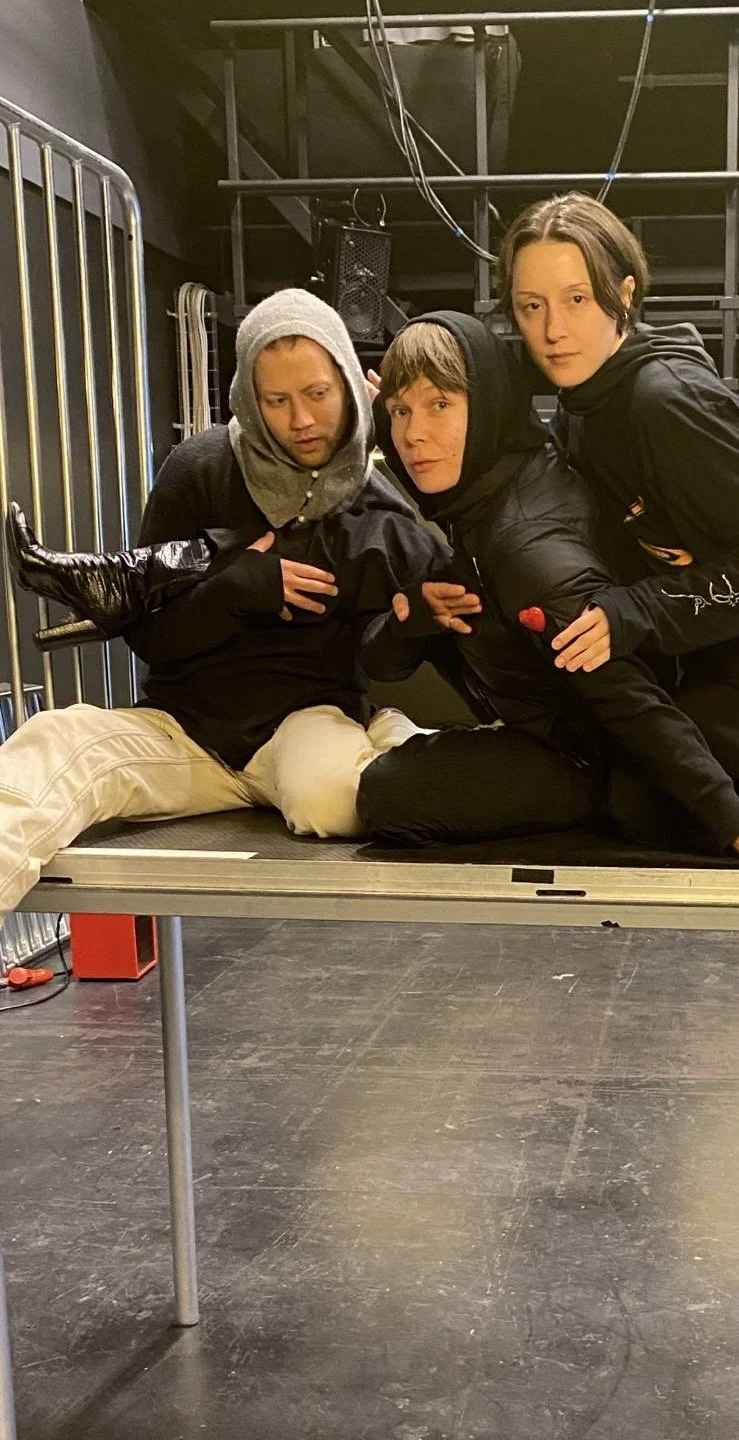
Image: Maija Mustonen
Maya Oliva: What makes me love dancing is that it has been my romantic partner my whole life. It has been a home and a place that I could always go back to. A place that grounds me in the act of feeling. Feeling my body, my skin, my flesh. Dance loves me back because it's always there for me, even in stillness. It envelops me, igniting movement, meeting me in the happiness and also in the drama or the tragedy of it.
MH: What kind of love exercises do you do through dancing?
Lintu Lunar: The way I practice love through my dancing is by always dancing to someone. I send a feeling, a prayer, an energy towards someone with the dance. I visualize the person to be with me—in me, in front of me—when I dance. And the whole dance becomes a dedicated poem for that person.
MH: What has been dearest to you in this creative process?
MO: What has been really dear to me is that LOVE&MAKING has now been in the making for two, maybe three years. We’ve gone through a lot of changes in life together with this piece. We’ve kept showing up for each other, no matter the circumstances — through artistic struggles, heartaches, rejections, and also happiness. At the core of it has always been this question: how do we come together and love each other, and love what we do, and love what dance has been for us? Why do we dance? Why do we share this love? What keeps us alive now, and what has kept us alive before? These questions kept coming to the surface. And at some point, we chose to focus less on what the final result or the final artwork would be, and more on nurturing the interaction between artists working together — especially in a difficult time, and in a moment where the current art field can feel very harsh towards the bodies of the dancers.
So what I’m really trying to say is this: it’s about acknowledging that harshness, and still choosing to come together, to dare to love each other, and to take care of one another.
LL: For me, the dearest part of this process has been how we come together through care — how we meet each other again and again by putting on and taking off different masks, different characters. There’s a playfulness in how these characters appear, disappear, and return, constantly meeting each other. Sometimes it feels like there are more than just three of us, because we all carry so many layers. And through those layers, I feel like I get to know Maya and Pie deeper and deeper. I begin to see where their love is placed, how it manifests in their personalities and in their souls. I feel nurtured by that love, and at the same time I find myself lowering my defenses, opening up, and coming into a kind of blossoming. It doesn't feel like we're doing this individually at all — it feels like we're doing it as one living thing, like one plant growing together. And that feeling, I think, is the dearest one I will cherish, even if we move into a phase where the making itself is no longer so urgent.
Pie Kär: I want to share how deeply moved I am by the skills we all bring — the skills and the care we bring when we negotiate the working culture we share. I feel like there is a very genuine wish to hear and understand and listen to one another. And there’s also bravery in being able to acknowledge the moments when we don’t manage to meet each other’s needs — when we miss something, or have a blind spot. I'm moved by the combination of safety and bravery that we share among us and the working culture that it has been nurturing — and keeps on nurturing. Because making a piece is wild. It’s an intense experience that a group of people go through together. And knowing that we all come into this with our own past experiences — as a group and as individuals — I find myself honestly astonished by the skills we hold, and how we carry them together.
MH: What kind of artwork are you giving birth to?
PK: My first thought is that we are giving birth to the artwork that has to come, that can come. It's about what is possible, and also about what we need to bring out right now, in this moment. We are giving birth to something personal. It's a first for this group of three, our first collaboration together. And yet, the piece carries traces of what we've done before, which we try to embrace and bring forward: paths connected to dancing, to performances, to the ways we make and the things we love in it. In a way, we’re giving birth to a little diary. Something that might also shine a light on what’s to come in our future paths of making. We are trying to be very honest with this piece. We’re not trying to make it cool. If it doesn’t become cool, that’s fine. What matters is answering questions for ourselves, and sharing that with the audience.
And from my perspective, what I bring into this piece is a passion for the audience’s path within it — a passion for how a piece can communicate possibilities. By possibilities, I mean very practical things: How can I place myself in this room? What can I do here? How can I be with this performance in different ways? So, in that sense, we’re giving birth not only to the piece itself, but also to possibilities for engagement, for presence, for connection.
