
Interview with MAR/MÆR
We interviewed the performance art duo MAR/MÆR, formed by Mari Pitkänen and Kaja Mærk Egeberg. Their site-specific performance, BEDROCK : : ROCKBED, will take place at Mustikkamaa from August 13–16.
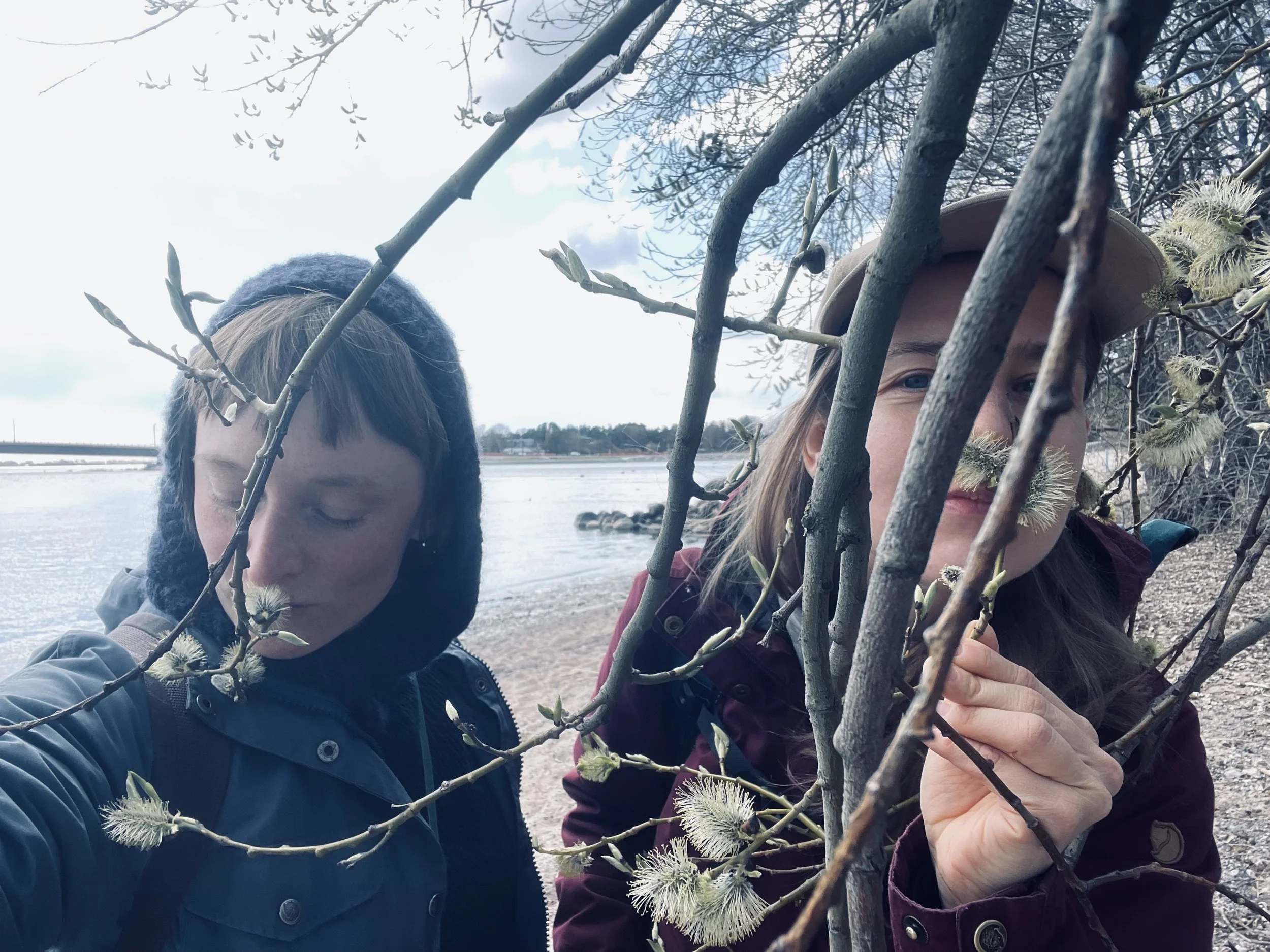
Photo: MAR/MÆR
Mad House: BEDROCK : : ROCKBED is the seventh volume of your Camouflage Strategies series. The series has evolved from the wall of the Lapeyrouse Cemetery in Port of Spain during the Trinidad and Tobago Carnival to a collaboration with oak trees and lichen in Søndermarken, and now to the cliffy and sandy areas of Mustikkamaa.
What has this series taught you about resilience, and what have you learned about symbiosis through your collaboration with the Mustikamaa lichen?
MAR/MÆR: Our Camouflage Strategies stemmed from an interest in finding ways to disappear and to transform ourselves into part of our surroundings as a performative act. Through our work with living systems such as trees and lichen, the concept of resilience has taken on a broader meaning.
Lichen reminded us that resilience is rarely an individual achievement. A lichen itself could be viewed as a form of collaboration, or described as more of a verb than a noun—more like a gathering of multiple agents than a single unit of a species. To grasp this on a deep level as a human being is a fascinating and unsettling endeavor, since the sense of being a singular subject is so deeply ingrained in us. It is a symbiosis between different organisms that survive through interdependence rather than autonomy, through porous forms of interaction.
Lichen taught us that resilience is a slow, ongoing, almost invisible process within living species. Lichen grows through attachment and adherence, through a continuous exchange. Some lichens grow only a millimeter a year, while others grow more. The result of this growth may not be the most extravagant expression in the plant kingdom, but rather gray and modest. Lichen can grow almost anywhere and thrives on dead matter. And as it lives, it creates new soil or organic matter for other plants to grow in. The porosity of lichen allows it to dry out for long periods, wait for more moisture, and then become active again. We know that lichen was sent into space for research purposes and returned to Earth, still alive and capable of photosynthesizing. So it survived the journey, and if you think about it, lichen does look a bit like an alien being.
MH: You describe the camouflaged creature as a "silent trickster"—one whose hiding is indistinguishable as either a defense or a lure. When you blend into a space, what do you hope the audience will experience?
MAR/MÆR: We hope to create a gentle disturbance in something familiar. A moment of enchantment or estrangement, where perception shifts and an invitation to embrace more-than-human relationships is open and malleable.
We want the audience to slow down. Our performances typically feature slow shifts and movements. It is an invitation for the audience to engage in a kind of deep listening. We invite them to linger or dwell and to focus on the relationships that surround us without us necessarily noticing them. We hope that the audience will perceive not only the performers but also other movements in the landscape.
Part of the work involves coming to terms with the limitations of our bodies and our perception. We also work with sound to speak to the senses. But if we manage to camouflage things well enough, we might be able to reveal to audiences, for a very brief moment, that their visual perception—and perhaps their memory—cannot be fully trusted, and that beyond this perception lies an entire world and another reality that does not always align with the perception we are capable of constructing. Our sensory organs are developed in a certain way and contribute to a specific understanding of that which is.
The humor of the work also lies in the limitations: the act of camouflage is bound to fail, since we also want to be found and seen in our attempt to remain completely hidden.
MH: The work lies at the intersection of post-human and feminist practices, exploring "in-betweenness and creatureness."
Why is the act of disappearing—of refusing to be a distinct, separate body—an important gesture in your work?
MAR/MÆR: Disappearing allows us to move away from the idea of the body as separate and self-contained. We are interested in what emerges when boundaries soften, when the body becomes part of a larger ecology of relations, materials, and forces. In that sense, disappearance is less an escape than an opening.
While working on *Camouflage* at Moss in 2023, we were both pregnant. The process of embodiment was truly symbiosis in action. We spent that time researching the phases of early pregnancy. During implantation, the blastocyst first makes contact with the wall of the uterus, triggering a chemical reaction. The blastocyst sort of disappears into the wall of the womb, and the womb’s surface sort of embraces and swallows it in—or so we like to think. And from thereon, the embryo creates its own space to grow within the wall. Suppose the act of disappearing is a cellular urge shared by many living creatures.
